Bedroom planning guide
Platform Bed Frames and Mattress Compatibility: What to Check Before You Choose
A platform bed can simplify a bedroom: one frame, a built-in support surface and, usually, no separate box spring. But “fits a double” or “made for a queen” is only the beginning. The mattress and frame must agree on dimensions, support and construction—and the whole arrangement has to work in the room you actually have.
The mismatch that causes trouble is often invisible in a product title. A mattress may be nominally the right size yet sit awkwardly inside the frame, overhang its edges or fail to receive the support its maker requires. Meanwhile, a frame that looks compact online may be difficult to carry up a narrow staircase or leave too little space for drawers and doors. A few careful checks, made before ordering, can prevent a costly and inconvenient surprise.
Platform beds are not a single design. Some use closely spaced slats; others have broad, solid or perforated panels. Some include a centre rail and additional legs, while others rely on a different structure altogether. Those details influence which mattresses are suitable, how weight is distributed and whether ventilation is adequate. The right question is not simply whether a mattress can be placed on a frame, but whether the two are designed to work together.
Start with measurements, not labels
Bed-size names are convenient shorthand, not a universal measuring system. A “queen” is commonly used in North American bedding, while UK retailers more often describe standard sizes as single, double, king and super king. Dimensions can vary by market and, in some cases, by manufacturer. A size name alone is therefore not enough to establish compatibility—particularly when buying a mattress and frame from different sellers.
Find the mattress’s stated width and length, then compare those figures with the frame’s internal sleeping area. The internal measurement is the space available between the rails or within the frame—not the overall footprint from the outside edges of the headboard and side rails. A frame can be substantially wider and longer than the mattress it holds, so exterior dimensions are useful for room planning but cannot confirm mattress fit.
Measure the frame’s inside width at more than one point if its shape or construction suggests the space may vary. Check the length from the inside of the headboard to the inside of the footboard, where applicable. A close, appropriate fit helps the mattress lie flat without being forced into place. Do not assume that an apparent gap is harmless or that a mattress can simply be squeezed into a smaller opening: follow the frame and mattress manufacturers’ instructions.
- Record the mattress dimensions: use the actual width and length, not just the size name on its label.
- Check the frame’s internal dimensions: distinguish the mattress platform from the frame’s full outside measurements.
- Confirm the intended size standard: ask whether a “queen” refers to a particular market’s mattress dimensions.
- Allow for any stated tolerance: consult the manufacturer if the measurements appear very close or do not match exactly.
A queen-size frame needs extra scrutiny
Searching for a platform bed frame queen can return products made for different markets. Before choosing one, establish the exact mattress dimensions the frame is intended to hold. If the mattress is sold as a queen and the frame is described as queen, verify that both labels follow the same sizing convention. This matters especially when a bed, mattress or bedding is imported or sold through a marketplace with listings from multiple countries.
Then consider the room around the bed. A queen-size sleep surface may be comfortable for two sleepers, but the frame adds to its footprint. Measure the bedroom’s width and length, and mark out the full outside dimensions—including headboard, footboard and any projecting legs—before committing. Leave practical clearance for walking, opening wardrobes and bedside furniture. Where the bed has drawers, make sure they can open without hitting a wall, radiator or other furniture.
Access is part of the calculation. Measure narrow hallways, stair turns, doorways and lifts along the route to the bedroom. Some frames arrive in sections; others have large components that may be hard to manoeuvre. Check package dimensions and assembly requirements as well as the completed bed’s footprint. An ideal frame that cannot reach the room is not much use.
Read the support requirements carefully
The support surface is the working heart of a platform frame. A mattress distributes weight across whatever lies beneath it, but mattresses differ in construction and can have specific rules about the kind of base they need. The maker’s guidance should take precedence over general assumptions about slats, panels or “universal” frames.
For a slatted frame, check the recommended spacing between slats and whether the mattress maker specifies a particular support arrangement. Wide gaps can leave parts of a mattress insufficiently supported; closely spaced slats may be required for some constructions. There is no single spacing figure that applies to every mattress. Compare the frame’s specifications with the instructions for the exact mattress model, and request clarification if either set of guidance is missing.
Also check how the slats are held in place. They may rest in brackets, sit on side rails or be secured by another method. Look for information about their material, thickness and load rating, and whether a centre support is included. A larger frame may need additional support beneath the middle; the design and requirements vary. Do not remove a centre rail or substitute a support arrangement unless the manufacturer says it is acceptable.
A solid platform has different considerations. It can provide broad, continuous support, but its ventilation characteristics depend on the material, openings and design. Follow the mattress maker’s advice about airflow and the bed maker’s care instructions. Avoid improvised boards or coverings that block an intended ventilation path unless the product guidance explicitly allows them.
Consider the mattress construction
Foam, pocket-sprung, hybrid and other mattresses are not interchangeable in every respect. Their internal structures may call for different foundations, and some models have detailed requirements relating to slat spacing, a flat surface or particular types of adjustable base. The word “platform” does not, on its own, guarantee compatibility with every mattress category.
For example, a foam mattress can be sensitive to the distribution of support beneath it. A sprung or hybrid model may have its own foundation specifications. These are not rules to infer from appearance: consult the manual or ask the manufacturer about the named mattress and proposed frame. If a mattress is delivered compressed in a box, that delivery method does not establish what base it needs once unpacked.
The same care applies if considering a particular mattress such as the Element Mattress. Its published description identifies foam construction, including an open-cell foam top layer and responsive foam beneath. That information describes the mattress, but it does not replace the maker’s full foundation guidance. Before pairing it with a platform bed, confirm the required support surface and spacing for the specific model.
Height, edges and everyday use
Compatibility is not only a matter of width and length. The height of the frame, mattress and any added topper together determines how high the sleeping surface sits. That affects getting in and out of bed, the look of the room and whether a headboard remains at a useful height. Measure the mattress thickness and frame height, then consider any topper or comfort layer you already use.
Check whether the frame has a lip or raised edge intended to keep the mattress in position. The available space should accommodate the mattress without compressing its sides. A frame designed to hold a mattress within a recessed area may behave differently from one with a flat, open platform. Keep the mattress centred and follow instructions about how it should sit on the support surface.
Bedding also deserves a quick check. A fitted sheet must suit the mattress dimensions and depth; a thick mattress or topper may call for deeper pockets. Adjustable bases, where used, can have their own requirements for sheets and other coverings. These details do not determine structural compatibility, but they help ensure that a well-fitted mattress is also practical to make and use.
Inspect the frame’s design and assembly
A platform frame’s construction affects stability as well as support. Look for clear assembly instructions, the stated maximum load and details about centre rails or legs. Confirm what the load figure includes and whether it applies to the frame alone or to the combined load of mattress and sleepers. Do not exceed the stated limit, and do not treat a visually sturdy frame as proof of a particular capacity.
If the frame is made from timber, metal or a combination of materials, the material label is only one part of the picture. Joinery, fasteners, rails and support components all contribute to how the assembled bed performs. Make sure the frame is assembled on a level surface and that every connection is secured as instructed. Recheck fittings after moving the bed or following the maker’s maintenance advice.
Some platform beds are designed to work without a box spring; others may allow alternative configurations. Never assume that a box spring is needed—or that it is permitted. Adding one changes the sleeping height and may affect how the mattress is supported. Read the product instructions for both the frame and mattress before introducing an extra layer.
Examples: what product descriptions can tell you
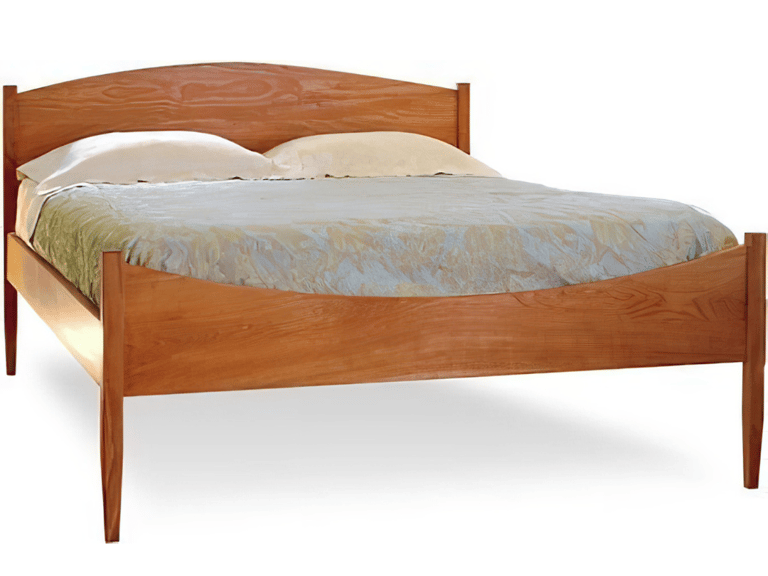
A detailed product page can help answer the first questions, but it may not answer all of them. The Maple Corner Woodworks Shaker Moon Bed Frame, for example, is described as a platform design with ten wide slats that interlock with hardwood dowels on the side rails. Its description also notes centre-reinforced support for king and California king sizes. Those are useful construction details to compare against a mattress maker’s requirements; they are not a substitute for confirming the exact size and specifications of the version being purchased.
The Cherry Moon Bed – Queen – Display Model is described as having a platform frame and solid-wood construction. Its listing identifies it as a queen-size bed, but buyers still need the actual internal dimensions and support details to verify a match with a particular mattress. Product names are a starting point for questions, not measurements in themselves.
When a listing does not state internal dimensions, slat spacing or load guidance, ask the seller before ordering. Request the figures in writing where possible. If the seller cannot confirm compatibility, the mattress manufacturer may be able to explain the base requirements, but a clear answer needs to refer to the specific frame design.
A practical checklist before you buy
Keep this short list beside you while comparing options:
- Write down the mattress’s exact width, length and thickness.
- Confirm that the frame’s internal sleeping area is intended for those dimensions.
- Check what country or sizing convention the product’s “queen” or other size label follows.
- Compare slat spacing, support layout and any centre rail with the mattress maker’s requirements.
- Check ventilation guidance for the mattress and the frame’s support surface.
- Confirm the frame’s stated load limit, assembly method and any additional support requirements.
- Measure the room, the full frame footprint and the route into the bedroom.
- Allow for bedside access, drawers, doors, radiators and other obstacles.
- Ask for missing specifications before purchase rather than guessing from photographs or labels.
The sensible match is the documented one
A platform bed can make a clean, straightforward foundation for a bedroom, but a successful pairing depends on details that are easy to overlook. The mattress must fit the internal space, its construction must suit the support surface, and the completed frame must work within the room and the route to it. A queen-size label, an attractive design or a general claim of broad compatibility cannot answer all three questions.
Start with measurements. Move on to the frame’s support structure, then compare it with the mattress manufacturer’s instructions. Finally, check the full footprint, access and assembly requirements. If a specification is absent or ambiguous, pause and ask. That small delay is preferable to discovering after delivery that the bed is the wrong size, the base is unsuitable or the frame cannot be assembled where it is meant to go.
The best bedroom setup is not necessarily the most elaborate. It is the one in which the frame, mattress and room make sense together—and whose compatibility can be verified before the first night’s sleep.